Wednesday, November 2, 2011
DJ Training on KTUH FM, Part 3
Last night I did my third training session at KTUH from 12-3 AM. I did my hour on the show from 12-1 AM because I was afraid I'd be nonfunctional if I waited until later. I had two exams during the day and had been up since about 7 AM. I tried to take a nap after I got home from school, but I couldn't fall asleep. All I could do was think about math (I had dreams about math the night before). Needless to say, I was exhausted when I finally got home and went to sleep at 3:33 AM this morning!
Here's my playlist from 12-1 AM last night/this morning:
*†Pimpbot - Meet You At the Bar - self-titled - Passout Records
*Fucked Up - A Little Death - David Comes to Life - Matador
*We Were Promised Jetpacks - Medicine - In the Pit of the Stomach - Fat Cat
*The Jim Jones Revue - Premeditated - *Burning Your House Down - Punk Rock Blues
*The Jim Jones Revue - Burning Your House Down - Burning Your House Down - Punk Rock Blues
Deer Tick - The Bar - Divine Providence - Partisan Records
Dig - Believe - self-titled - Radioactive
Seaweed - Start With - Spanaway - Hollywood
Hi-Standard - California Dreaming - Survival of the Fattest - Fat
June of 44 - Of Information and Belief - Four Great Points - Quarterstick
The Calm Blue Sea - The Struggle - Siegfried -
Sonic Youth - New Hampshire - Sonic Nurse - Geffen
Freakshow - Recreated - Love is Dead
*‡ Wild Flag - Boom - Wild Fag - Merge
* New Release (will be charted for CMJ)
† Local Band
‡ I was going to play this, but I ran out of time. :(
Recommendation:
One of the other guys, Nash, played a band that was pretty good: Tame Impala. They're from Australia. Check them out!
Wednesday, October 26, 2011
DJ Training on KTUH FM
Well, it's official - I'm training to be a new DJ on KTUH Honolulu, 90.3 FM. If you haven't heard of it, KTUH is the student radio station at the University of Hawaii at Manoa. It broadcasts on three frequencies on the island of Oahu (with almost 100% coverage), a digital cable channel, and streams live on their website, http://www.ktuh.org.
I'm really excited about the opportunity to become a DJ on KTUH and I consider it a great honor and privilege to be a part of the station. As far as I'm concerned, KTUH rules the airwaves and there's not a single other channel on the radio worth listening to. I've always had a deep love and appreciation for college radio that stems back toward my preteen years when I'd scour the lower bands of the FM dial in search of sounds that would alleviate the banal mind warp of commercial stations. By seeking out college radio, independent radio, and public radio I gained an appreciation for Blues, Jazz, Reggae, World Music, Punk, and most importantly, underground and indie rock. These stations provide a valuable public service by sharing alternative sounds and opinions with the public and I'm certain that many people, young and old are turned on to new music on a regular basis because of such stations.
When I first moved to Hawaii in 2004, I was static to find out about KTUH. I worked long hours driving around in circles, often in the middle of the night, and I would always have KTUH on the radio. I became a big fan of many great shows that have come and gone over the years and my love and appreciation for the station has grown steadily. I never thought that there would come a day when I would become a part of the station and its history, with my own musical selections and my voice transmitting from its airwaves, but here I am.
Ladies and gentlemen, I am thrilled beyond belief.
I'm doing DJ training with two other guys. We're being taught the wonderful ways of the station by the knowledgeable and talented DJ Mr. Nick. I think that we're all doing really well.Our training iteration is Wednesday morning from 12:00-3:00 AM. This morning was our second week's training. Last week we had a sort of crash coarse and this week we got a bit more in depth and each of us took a full hour playing music and familiarizing ourselves with the equipment, talking on the air, and station procedures. Life is pretty damn good.
We'll be on again next week Tuesday night/Wednesday morning from 12-3 AM so tune on the radio or on the web and give us a listen. If you're feeling really ambitious you can even call in a request at (808) 956-7289.
Here's my playlist from the show; I was on from 2-3 AM:
Artist Song Album Label
Tom Waits – Hoist that Rag – Real Gone – Anti
June of 44 – Sharks and Sailors – Anatomy of Sharks EP – Quarterstick
Against Me! – Baby I’m An Anarchist – Reinventing Axle Rose – Fat
Sexpod – Pretty Thing – Goddess Blues – Slab Recordings
Warpaint – Set Your Arms Down – The Fool – Rough Trade
The Folk Implosion - Insinuation – Dare to Be Surprised – The Communion Label
Mogwai – With Portfoli – Young Team – Jetset
Fuck – Compromise – Pardon My French – Matador
Astronautalis – Thomas Jefferson – This Is Our Science – Fake Four, Inc
The Jim Jones Revue – Shoot First – Burning Your House Down – Punk Rock Blues Records
Black Square – Black Square – Black Square – self released
Fu Manchu – Mongoose – California Crossing – Mammoth
The other guys' playlists are under the "Read More" cut.
Monday, October 3, 2011
Kaho'olawe Bound
I'm soon to officially become a published photographer. One of my shots of Kaniakapupu Palace is going to be featured in the November/December 2011 issue of Innov8 Magazine! It's the inflight magazine for Go! Airlines. I've never flown with them before, but I've flown a lot of other airlines and I have NEVER seen an airplane magazine that's this snazzy. I get photo credit, a voucher for a one way ticket, and a copy of the magazine as payment. Bam! I'll take it. Check out the magazine, it's rather nifty (also, you can view the complete magazine when it comes out so you can see my picture there when it prints). Also, check out my Kaniakapupu Palace set on flickr, the image that will be posted is in there. They narrowed it down to 6 possibilities, but didn't tell me which. And speaking of flickr, my account is now over 75,000 views!
In other news, tomorrow I'm leaving Oahu to do something rare and take part in something special. I'm going to Kaho'olawe! Kaho'olawe is the smallest of the 8 main Hawaiian islands. It is a sacred place to Hawaiians, as it is considered to be the earthly form of the god Kanaloa, the god of the ocean. It was once used as a training site for Hawaiian seafaring navigators. There's very little groundwater on the island and it has been periodically populated and uninhabited through out history depending upon availability of water or lack there of. In modern times, the island was pretty much destroyed. After the arrival of Europeans and Americans the island was used for a penal colony and then various ranching enterprises took over. The island was systematically deforested and stripped of much of its flora by feral goats. The deforestation lead to a further lack of precipitation which made the island more or less uninhabitable. During World War II the island was used for training and it was subject to constant bombings until 1990. The Navy did a cleanup of unexploded ordinance on the island, but the millions of pounds of scrap that they removed from the island was only a fraction of the unexploded ordinance left behind by decades of military target practice, and the clean up was only on the surface level. As a result, the island remains extremely hazardous. Local interest in Kaho'olawe was sparked in the 1970s as part of the Hawaiian cultural and spiritual renaissance. After a long fight to stop the bombings and military control of the island, Kaho'olawe is now held by a trust under the state government of Hawaii and it is to be used cultural and spiritual purposes only. The island is still extremely dangerous and only a few organizations staffed by a number of intrepid volunteers are allowed to travel to the island. I'll be going as a volunteer for the Kaho'olawe Island Reserve Commission from 3-6 October and we'll be working on things like erosion control and reforestation. I am extremely privileged to be taking part in this project. Now I'd better go pack. I have to go to bed early, my flight to Maui is dreadfully early in the morning.
Labels:
hawaii,
kaho'olawe,
kahoolawe,
kaniakapupu palace
Location: Honolulu, Hawaii
Makiki - Tantalus, Honolulu, HI, USA
Friday, September 23, 2011
Protect Kaho'olawe 20th Anniversary
September 25, 2011, the Protect Kaho'olawe Ohana is having a 20th anniversary celebration to mark the ending of the US Military's bombings of the sacred island of Kaho'olawe.
Fore more info: visit http://www.kahoolawe.org.
See also: http://www.kahoolawe.hawaii.gov
Monday, June 27, 2011
Stuff to do on Oahu
Here's a link to the local music scene in Hawaii: http://www.808shows.com it gives the listings of band performances and venue listings.
Here's something swanky for the hip set: http://www.artafterdark.org
I'm not sure if they have events in the winter. Check the site for details. The events are usually loads of fun.
This is the coolest thing to do the first Friday of every month: http://www.firstfridayhawaii.com art, food, music, booze and loads of people in China Town.
If you like Lost, if you search the web you can find listings of places where they do/have done filming. Also, you can check out places where they've filmed movies and stuff. Just search google, you'll find alot.
If you like hiking, there are trails literally everywhere. You see all those draws and spurs on the sides of mountains where the housing settlments creep up, if you drive to the top of one of those or into the back of any of those valleys below you're almost gauranteed to find a trail. Also, for some breath taking views of town and and interesting drive you should drive Tantalus/Round Top Drive (google it for directions). Just remember to be respectful of locals and traditions/customs, the land, etc.
Stay the hell out of the water in the North Shore during the winter. That's big surf time and inexperienced folks get dead in the water real quick if they're silly enough to go in or onto the rocks.
Turtles are protected - hands off! Also, don't touch/stand on/break coral.
Sharks Cove and Haunama Bay are snazzy places to go snorkeling/scuba diving. www.hanaumabay-hawaii.com/
If you're a coffee head check out Coffee Gallery in Haleiwa and Coffee Talk in Kaimuki (3601 Wai'alae Ave) are boss. Coffee Talk used to do all ages punk/indie shows but stopped (unless they started again and I don't know about it).
Matsumoto's Shave Ice in Haleiwa is LEGEND! (Aoki's, the place next door to it, is good too) I the lychee flavor (mixed with one or two randoms) is my favorite.
Don't forget to try the lau lau with poi on the side. Ono grindz fo da kine! (and have you noticed yet that McDonald's has spam and rice on the breakfast menu?)
The Liquor Collection in Ward Warehouse is great for a wide assortment of boozy libations.
Movie Theaters: Ko'olau Stadium 10 in Kaneohe and Dole Cannery in town play some independent and foreign films, as well, with a lot of run of the mill stuff as well. The theater at Ward plays movies 10 decibals higher volume than anywhere else on the island. The stadium seating there is great and the area is spectacular for people watching if you can stand the ear shattering volume of the movies.
Also, if you're in need of some midnight grub, skip Denny's and check out Anna Miller's. They're open 24 hours and the waitress outfits are hilarious.
Beaches: Waimanalo Bay Park rules. Ala Moana is a good swimming spot if your in town. Always keep a towel and swim suit in the trunk of your car for impromptu swimming opportunities.
It may be worth it to switch your license over for a Hawaii one for the Kamaaina discounts. If you have a valid out of state license, you will have to take the written exam, but not the road test.
Also, there's a weekly entertainment newspaper called The Honolulu weekly that has lots of good stuff in it. It's free and it's all over the place or at http://honoluluweekly.com and craigs list is pretty active, for all the stuff that the site is known for, in Honolulu.
Transportation: TRAFFIC is a bitch. The island is basically habitated on the low lands with uninhabitable mountains all up in the middle. That means there's basically one way to get anyplace that you need to go. You can't take much for back road shortcuts or cut through towns and what not like on the mainland. Avoid the H1 at all cost during morning/evening rush hour! It becomes a literal parking lot. If you're going the opposite route of traffic then you're ok- morning all the commuters head towards town and evening they all head away. The Kam Highway gets pretty backed up too during rush times. I suggest that you buy a nice big map and familiarize yourself with streets/towns/areas. I have some tricks of the trade to bypass traffic, but it's complicated to explain to someone who doesn't know the lay of the land. I hear that The Bus system (http://www.thebus.org/) is pretty efficient, though I've only taken twice. Biking can be pretty hairy with traffic and steep hills, depending on where you live and isn't really practical for going long distances/across the island because of the way the roads are set up. Some areas have been creating bike paths.
Meet Ups/Making friends: MAKE FRIENDS WITH LOCALS as much as possible! They have better insight into like, everything about Hawaii that you wouldn't find out about otherwise. Don't be an apartment rat or townie. Get out and explore as much as possible, even if you've got to do it on your own- do it. You're going to be in paradise, make the best of it and enjoy!
Search for meet up groups on these sites-
http://www.meetin.org
http://www.meetup.com (there's a great hiking group on this site)
Here's something swanky for the hip set: http://www.artafterdark.org
I'm not sure if they have events in the winter. Check the site for details. The events are usually loads of fun.
This is the coolest thing to do the first Friday of every month: http://www.firstfridayhawaii.com art, food, music, booze and loads of people in China Town.
If you like Lost, if you search the web you can find listings of places where they do/have done filming. Also, you can check out places where they've filmed movies and stuff. Just search google, you'll find alot.
If you like hiking, there are trails literally everywhere. You see all those draws and spurs on the sides of mountains where the housing settlments creep up, if you drive to the top of one of those or into the back of any of those valleys below you're almost gauranteed to find a trail. Also, for some breath taking views of town and and interesting drive you should drive Tantalus/Round Top Drive (google it for directions). Just remember to be respectful of locals and traditions/customs, the land, etc.
Stay the hell out of the water in the North Shore during the winter. That's big surf time and inexperienced folks get dead in the water real quick if they're silly enough to go in or onto the rocks.
Turtles are protected - hands off! Also, don't touch/stand on/break coral.
Sharks Cove and Haunama Bay are snazzy places to go snorkeling/scuba diving. www.hanaumabay-hawaii.com/
If you're a coffee head check out Coffee Gallery in Haleiwa and Coffee Talk in Kaimuki (3601 Wai'alae Ave) are boss. Coffee Talk used to do all ages punk/indie shows but stopped (unless they started again and I don't know about it).
Matsumoto's Shave Ice in Haleiwa is LEGEND! (Aoki's, the place next door to it, is good too) I the lychee flavor (mixed with one or two randoms) is my favorite.
Don't forget to try the lau lau with poi on the side. Ono grindz fo da kine! (and have you noticed yet that McDonald's has spam and rice on the breakfast menu?)
The Liquor Collection in Ward Warehouse is great for a wide assortment of boozy libations.
Movie Theaters: Ko'olau Stadium 10 in Kaneohe and Dole Cannery in town play some independent and foreign films, as well, with a lot of run of the mill stuff as well. The theater at Ward plays movies 10 decibals higher volume than anywhere else on the island. The stadium seating there is great and the area is spectacular for people watching if you can stand the ear shattering volume of the movies.
Also, if you're in need of some midnight grub, skip Denny's and check out Anna Miller's. They're open 24 hours and the waitress outfits are hilarious.
Beaches: Waimanalo Bay Park rules. Ala Moana is a good swimming spot if your in town. Always keep a towel and swim suit in the trunk of your car for impromptu swimming opportunities.
It may be worth it to switch your license over for a Hawaii one for the Kamaaina discounts. If you have a valid out of state license, you will have to take the written exam, but not the road test.
Also, there's a weekly entertainment newspaper called The Honolulu weekly that has lots of good stuff in it. It's free and it's all over the place or at http://honoluluweekly.com and craigs list is pretty active, for all the stuff that the site is known for, in Honolulu.
Transportation: TRAFFIC is a bitch. The island is basically habitated on the low lands with uninhabitable mountains all up in the middle. That means there's basically one way to get anyplace that you need to go. You can't take much for back road shortcuts or cut through towns and what not like on the mainland. Avoid the H1 at all cost during morning/evening rush hour! It becomes a literal parking lot. If you're going the opposite route of traffic then you're ok- morning all the commuters head towards town and evening they all head away. The Kam Highway gets pretty backed up too during rush times. I suggest that you buy a nice big map and familiarize yourself with streets/towns/areas. I have some tricks of the trade to bypass traffic, but it's complicated to explain to someone who doesn't know the lay of the land. I hear that The Bus system (http://www.thebus.org/) is pretty efficient, though I've only taken twice. Biking can be pretty hairy with traffic and steep hills, depending on where you live and isn't really practical for going long distances/across the island because of the way the roads are set up. Some areas have been creating bike paths.
Meet Ups/Making friends: MAKE FRIENDS WITH LOCALS as much as possible! They have better insight into like, everything about Hawaii that you wouldn't find out about otherwise. Don't be an apartment rat or townie. Get out and explore as much as possible, even if you've got to do it on your own- do it. You're going to be in paradise, make the best of it and enjoy!
Search for meet up groups on these sites-
http://www.meetin.org
http://www.meetup.com (there's a great hiking group on this site)
Waimano Training School and Hospital, Pearl City, Hawaii
In November I had to go up Waimano Home Road for a job interview. This is the third time that I've been up there. The first time was for the Waimano Ridge hike a few years ago, and the second was last week for pre-employment stuff. When I first visited the area for the hike I was really curious about what was in the compound as there was an armed guard at the entrance. I never thought I'd get to go inside, but when I went last week I was amazed at all the abandoned buildings on the premises. It's like a mini-ghost-town.
This is a shot of the view halfway between where my car was parked and where I started exploring. It was difficult to see the view with all the weed overgrowth.
Ni'ihau
Ni'ihau is the northern most of the 8 main Hawaiian islands and is the smallest of the inhabited islands. It is often referred to as "The Forbidden Island," because it has been privately owned by a single family since 1864. The island has no electricity, TVs, hospitals, or other amenities. They live a traditional lifestyle and speak Hawaiian as their first language. The Ni'ihau incident occurred during attack in WWII when a Japanese pilot crashed on the island and committed a load of chaos before being killed.
Presently, Keith Robinson fights to preserve the way of life for the islands residents and continues to cultivate endangered Hawaiian flora. The island is also an important refuse for various endangered indigenous fauna including several bird species and the Hawaiian Monk Seal.
Robinson Crusader, a short documentary about the island's current owner and caretaker:

(from http://www.mrmovietimes.com/watch-now/50049206/Robinson-Crusaderr)
Shigenori Nishikaichi, the Japanese pilot who crashed on the island:
Presently, Keith Robinson fights to preserve the way of life for the islands residents and continues to cultivate endangered Hawaiian flora. The island is also an important refuse for various endangered indigenous fauna including several bird species and the Hawaiian Monk Seal.
Robinson Crusader, a short documentary about the island's current owner and caretaker:
(from http://www.mrmovietimes.com/watch-now/50049206/Robinson-Crusaderr)
Shigenori Nishikaichi, the Japanese pilot who crashed on the island:
Location: Honolulu, Hawaii
Kaimuki, Honolulu, HI, USA
Learn To Speak Hawaiian
8 CDs in on folder. Go here:
hxxp://www.mediafire.com/?sharekey=4b111
(change xx to tt) |
Location: Honolulu, Hawaii
Kaimuki, Honolulu, HI, USA
Aincient Hawaiian Weddings
Ancient Hawaiian Weddings
B Rev. Dr. Bernadette K. Park
Ancient Hawaiian cultural traditions include ho’ao pa’a (marriage), a custom by which a man and a woman were bound in a lasting union’ a man was not to desert his wife nor a woman her husband. At one time unions were divided into two classes, those in which a man took many wives and a woman took many husbands, and the more commonplace marriage of the one wife and one husband arrangement. In ancient times, it was the aristocracy and privileged who were permitted more than one wife or husband.
The makua (parents) of the kane (boy) and the wahine (girl) whishint to marry discussed the matter umong themselves first. After the parents had reached an agreement, the kane and wahine were invited to hear the wishes of the respective parents, and if agreeable, the two were united with a ho hiki aku (vow) which commanded them to take care of each other. They were told to work in order to prepare for a life together. When the advising was pau (ended), the kane and wahine would honi (embrace) to seal the pact, and they became husband and wife. This marriage was considered binding until death.
Another tradition of ho’ao pa’a was for the man’s makua to send a messenger with ho’okupu (gifts) to the woman and the parents. They were valuable ho’okupu of hulu (feathers) of the mamo and brids for leis or capes, finely designed pawehi (mats), pearls, ivory, tapa, fish nets, fish lines, iron adzes, pigs, dogs, fowl, poi and la’au (herbal, medicinal plants). Then, the woman’s makua would in return send a messenger with lou (hooks) or lou ‘ulu (breadfruit hooks), attesting to the betrothal of the tow parties in a bond of marriage. As the marriage day approached, the relatives of the kane and wahine would prepare for a luau (feast). The man’s relatives build the hale (house) to host the marriage ceremony and feast, and both families prepared the food.
On the marriage day, the woman’s relative gathered her property and other wai wai (goods) upon a decorated manele (stretcher) to the home of husband-to-be. Upon receiving them, the family of the husband-to-be gave the relatives of the woman rich gifts and land, if they had it. The woman’s relatives would offer the same. This last exchange on the wedding day sealed the relationship between the two families for a lifetime.
An appropriate oil (chant) of ancient Hawaii was spoken by the kahu (leader or minister) to help to guide the matrimonial ceremony. Friends and family were encouraged to participate in the chanting as well. A kappa (or tapa) was prepared ahead of time by beating bark till it resembled cloth. Vibrant colors, using dyes extracted from plants were worked into designs on the kappa. This cloth was draped over the couple or held behind them throughout the ceremony, until, at the end, they were enfolded in it. The kappa was the enclosure in which the wedded couple would consummate their marriage, to the encouragement of their families and friends.
A common thread in the tradition was that couples would marry on the “huna moon” which was the eleventh day of the month at sunrise, the beginning of a new day.
Bibliography:
Ka Poe Kahiko, The People of Old
by Samuel Manaikalani Kamakau; 1931
Bishop Museum Press; A me Kumu John Lake;
HWM Arts and Culture, April 2005
B Rev. Dr. Bernadette K. Park
Ancient Hawaiian cultural traditions include ho’ao pa’a (marriage), a custom by which a man and a woman were bound in a lasting union’ a man was not to desert his wife nor a woman her husband. At one time unions were divided into two classes, those in which a man took many wives and a woman took many husbands, and the more commonplace marriage of the one wife and one husband arrangement. In ancient times, it was the aristocracy and privileged who were permitted more than one wife or husband.
The makua (parents) of the kane (boy) and the wahine (girl) whishint to marry discussed the matter umong themselves first. After the parents had reached an agreement, the kane and wahine were invited to hear the wishes of the respective parents, and if agreeable, the two were united with a ho hiki aku (vow) which commanded them to take care of each other. They were told to work in order to prepare for a life together. When the advising was pau (ended), the kane and wahine would honi (embrace) to seal the pact, and they became husband and wife. This marriage was considered binding until death.
Another tradition of ho’ao pa’a was for the man’s makua to send a messenger with ho’okupu (gifts) to the woman and the parents. They were valuable ho’okupu of hulu (feathers) of the mamo and brids for leis or capes, finely designed pawehi (mats), pearls, ivory, tapa, fish nets, fish lines, iron adzes, pigs, dogs, fowl, poi and la’au (herbal, medicinal plants). Then, the woman’s makua would in return send a messenger with lou (hooks) or lou ‘ulu (breadfruit hooks), attesting to the betrothal of the tow parties in a bond of marriage. As the marriage day approached, the relatives of the kane and wahine would prepare for a luau (feast). The man’s relatives build the hale (house) to host the marriage ceremony and feast, and both families prepared the food.
On the marriage day, the woman’s relative gathered her property and other wai wai (goods) upon a decorated manele (stretcher) to the home of husband-to-be. Upon receiving them, the family of the husband-to-be gave the relatives of the woman rich gifts and land, if they had it. The woman’s relatives would offer the same. This last exchange on the wedding day sealed the relationship between the two families for a lifetime.
An appropriate oil (chant) of ancient Hawaii was spoken by the kahu (leader or minister) to help to guide the matrimonial ceremony. Friends and family were encouraged to participate in the chanting as well. A kappa (or tapa) was prepared ahead of time by beating bark till it resembled cloth. Vibrant colors, using dyes extracted from plants were worked into designs on the kappa. This cloth was draped over the couple or held behind them throughout the ceremony, until, at the end, they were enfolded in it. The kappa was the enclosure in which the wedded couple would consummate their marriage, to the encouragement of their families and friends.
A common thread in the tradition was that couples would marry on the “huna moon” which was the eleventh day of the month at sunrise, the beginning of a new day.
Bibliography:
Ka Poe Kahiko, The People of Old
by Samuel Manaikalani Kamakau; 1931
Bishop Museum Press; A me Kumu John Lake;
HWM Arts and Culture, April 2005
Labels:
weddings
Location: Honolulu, Hawaii
Kaimuki, Honolulu, HI, USA
Wednesday, December 15, 2010
Sand Island
Yesterday I had more fun than I have for awhile. I went down to Sand Island to try and sell some old army crap to the surplus store and to check out the old bunkers at the park. I wanted to do the surplus store and then the park, but I accidentally drove past my turn off and decided to do the park first. I didn't think that I'd be there for nearly as long as I was, but I covered a lot of ground and saw some pretty weird sights. I've been to the park maybe twice, but only did a drive through- I'd never gotten out of the car to do a proper walk about. I don't recall seeing anything particularly notable in my past visits. Recently, I heard that there were some old WWII bunkers out there so I decided to do some investigating. Well, the bunkers are there and right out in the main area of the park so I don't know how I didn't notice them on the past trips or maybe I didn't realize what they were. Also, I don't know how the hell I didn't notice the big tower as it's a rather giant feature right in the midst of the park grounds. I followed the road as far as I could drive and then parked my car and set out on foot through the wastelands. Sand Island is an industrial harbor area of Honolulu. There are a lot of shipping warehouses and other things of that nature. The first thing that I came upon was a set of derelict baseball fields. After that I found a muddy lot of rubble on the shore with a set of weirdly cryptic log arches and a bunch of semi-abandoned construction vehicles. Continuing down the shore of the wastelands I came across two separate nude men, two homeless encampments, a BMX track, a mysterious island with several anarchic squatter type houses on stilts, and a yard full of outrigger canoes. On the way back I walked along the beach around the point rather than trekking through all the brush back through the baseball fields. I saw several more nude or semi-nude men including one older Asian man who was incredibly tan and wearing one of those 80s style wireless AM/FM headsets with the antenna on it. He was staring at me. It was very sketchy. The whole place was sketchy and weird and absolutely, totally heavenly. The park afforded some spectacular views of Honolulu and Diamond Head and the surrounding areas.
No one's keeping score:


Looking back:

No one's keeping score:
Looking back:
Tuesday, December 14, 2010
Birds
I just saw a Japanese White-Eye bird (aka Mejiros) eating papayas in my yard.
These birds were introduced to Hawaii in 1937.

(not my picture)
http://www.honoluluzoo.org/japanese_whit e-eye.htm
I recently saw a Hawaiian Moorhen* (‘alae ‘ula in Hawaiian) in a drainage ditch down the street:

(also not my picture)
They are endangered and extremely rare. They can only be found on Oahu and Kauai.
http://www.fws.gov/pacificislands/fauna/H Imoorhen.html
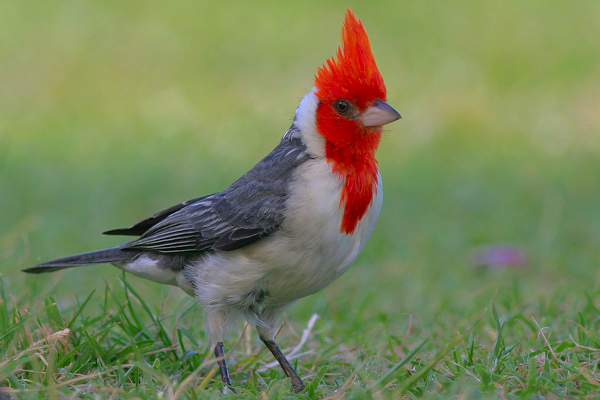
I see these Red-Crested Cardinals (aka Brazilian Cardina) once in awhile.
They were introduced to Hawaii in 1930 from South America.

(you may have guessed, not my pic)
Zebra Doves are the pigeons of Hawaii. They're everywhere!

I see these Northern Red Cardinals in my yard fairly often.

It's the same species of Northern Cardinal found in North America
and was introduced to Hawaii. In the islands it's found on Oahu and
The Big Island. I love catching their flashes of red in the Plumeria Trees
in my front yard!
The Java Finch (Java Sparrow):

This is another fairly common bird that was introduced from foreign lands.
I don't think that I've ever seen any in my yard, though.
We also have owls in Hawaii! I'll never forget the first time that I saw one because it scared the crap out of me! I was on patrol in the Aliamanu Crater and was on an old bunker access road hiding out in the dark. I heard this loud crashing noise in the brush that sounded like a troupe of Menehunes were coming to get me. I saw the shadow of a large bird land on a utility line. I shined my patrol car's spot light up and saw to my amazement that it was an owl! Prior to that I did not know that there were owls in Hawaii. After that I started seeing them infrequently at night, especially while driving through the Dole Pineapple fields at night. On Maui I was sitting in a Heiau at night and there were all these weird bird noises. I was talking to Coral on my cell phone and she said that it was owls. They were making quite a horrible ruckus. Here are a type of owl that lives on Oahu:
Short-Eared Owl* (Pueo in Hawaiian):
This one's endangered on Oahu, but fares better on the other islands.

Cattle Egret:

These guys are also really common and can be seen just about everywhere.
They frequent large grassy areas such as parks and playgrounds, especially when they're being mowed.
I saw one on top of a car in the Wal-Mart parking lot in Pearl City just the other day.
We don't have a lot of endemic avian species left here in Hawaii. Most of them were wiped out by other invasive species such as rats and mongoose. The mongoose were introduced to kill the rats, but there was an error because one species is nocturnal and the other isn't. Then the mongoose ended up finding the local bird species to be an easier prey.
* Endemic to Hawaii
These birds were introduced to Hawaii in 1937.
(not my picture)
http://www.honoluluzoo.org/japanese_whit
I recently saw a Hawaiian Moorhen* (‘alae ‘ula in Hawaiian) in a drainage ditch down the street:
(also not my picture)
They are endangered and extremely rare. They can only be found on Oahu and Kauai.
http://www.fws.gov/pacificislands/fauna/H
I see these Red-Crested Cardinals (aka Brazilian Cardina) once in awhile.
They were introduced to Hawaii in 1930 from South America.
(you may have guessed, not my pic)
Zebra Doves are the pigeons of Hawaii. They're everywhere!
I see these Northern Red Cardinals in my yard fairly often.
It's the same species of Northern Cardinal found in North America
and was introduced to Hawaii. In the islands it's found on Oahu and
The Big Island. I love catching their flashes of red in the Plumeria Trees
in my front yard!
The Java Finch (Java Sparrow):
This is another fairly common bird that was introduced from foreign lands.
I don't think that I've ever seen any in my yard, though.
We also have owls in Hawaii! I'll never forget the first time that I saw one because it scared the crap out of me! I was on patrol in the Aliamanu Crater and was on an old bunker access road hiding out in the dark. I heard this loud crashing noise in the brush that sounded like a troupe of Menehunes were coming to get me. I saw the shadow of a large bird land on a utility line. I shined my patrol car's spot light up and saw to my amazement that it was an owl! Prior to that I did not know that there were owls in Hawaii. After that I started seeing them infrequently at night, especially while driving through the Dole Pineapple fields at night. On Maui I was sitting in a Heiau at night and there were all these weird bird noises. I was talking to Coral on my cell phone and she said that it was owls. They were making quite a horrible ruckus. Here are a type of owl that lives on Oahu:
Short-Eared Owl* (Pueo in Hawaiian):
This one's endangered on Oahu, but fares better on the other islands.
Cattle Egret:
These guys are also really common and can be seen just about everywhere.
They frequent large grassy areas such as parks and playgrounds, especially when they're being mowed.
I saw one on top of a car in the Wal-Mart parking lot in Pearl City just the other day.
We don't have a lot of endemic avian species left here in Hawaii. Most of them were wiped out by other invasive species such as rats and mongoose. The mongoose were introduced to kill the rats, but there was an error because one species is nocturnal and the other isn't. Then the mongoose ended up finding the local bird species to be an easier prey.
* Endemic to Hawaii
Subscribe to:
Posts (Atom)